Company profiles
What should a company profile include?
Prepare the content, artwork and delivery requirements for a company profile that explains your business.
The short answer
Start with a clear brief.
A company profile should explain who your business serves, what it offers and why its experience is relevant to the reader. Start with approved company information, useful service or product detail, credible examples and a clear contact route. Choose the sections and length around the intended use.
Decide who will read the profile.
A first introduction, a sales meeting and a supplier submission can need different levels of detail. Tell the designer who the reader is and what they should understand or do after reading. This makes the content selection more useful than filling a preset number of pages.
For BRKZ, the confirmed brief was a company profile to showcase the business. Its supplied artwork gives company and product information distinct spaces. That is a practical example of organising a business presentation around its purpose.
Gather the information that explains the business.
The following sections are useful starting points. Include the ones that serve your reader, and support statements with current information.
- Company introduction: describe the actual business, audience and areas served in straightforward language.
- Services or products: explain the main offer and group related items so the reader can find what matters.
- Capabilities and approach: show how you work and which strengths are relevant to the intended customer.
- Project or product evidence: choose examples that demonstrate the offer, with short factual descriptions and usable images.
- Supporting information: add team details, credentials or client references where relevant and approved for this use.
- Contact details: use current channels and a clear next step for the reader.
Prepare the content before page design.
Keep the approved text in one organised document and the images in a clearly named folder. Identify anything still missing. This helps the designer distinguish final material from placeholders and reduces conflicting versions during review.
Supply the logo and any existing brand guidance. If you want the profile to refine the identity, make that a separate scope decision. Company-profile design can also use an existing logo and visual direction.
- Approved company name, introduction, service or product information and contact details.
- Selected project descriptions and original images with clear captions.
- Logo files, brand colours and any available typography or layout guidance.
- An owner for factual checks and a person who can approve the final content.
- The required language versions and any text still needing editing or translation.
Plan the language versions and reading order.
Decide whether Arabic and English should appear in one document or in separate versions. Agree who supplies, translates and reviews each language. Right-to-left Arabic and left-to-right English need appropriate layouts; adding translated text to an already crowded page can change the design requirements.
A simple starting order is a cover and introduction, followed by the offer, selected evidence and contact information. Add vision, mission or other company sections when they help explain the business. This is an adaptable outline, not a fixed page-count package.
The BRKZ gallery includes Arabic cover, steel-section and catalogue pages, plus supplied English vision-and-mission artwork. You can inspect the actual layouts in the case study.
Agree the format before the final export.
A profile shared by email, a printed brochure and a source file for future editing have different handover requirements. Tell the designer how the material will be used before production begins.
| Use | What to agree |
|---|---|
| Digital PDF | File size, readable text, working links and the intended screen-reading experience. |
| Printed profile | Final dimensions and the printer’s required production specifications. |
| Future editing | Which editable files are included and how your team will use them. |
Design, content writing, translation and printing should each have a clear owner. Do not assume a quote includes every production or source-file requirement; ask for the deliverables to be listed.
Review the profile as a buyer would.
Read the complete document in order rather than checking isolated pages. Confirm that someone unfamiliar with your business can understand the offer and find the next step. Then check the facts, language and delivery formats.
- Company names, service descriptions, numbers and supporting claims are accurate.
- Pictures and captions describe the intended projects or products.
- Arabic and English versions have been checked by the agreed language reviewer.
- Contact details and digital links work in the final exported file.
- The agreed files are clearly named and the final approved version is easy to identify.
From our delivered work
A profile built to showcase BRKZ
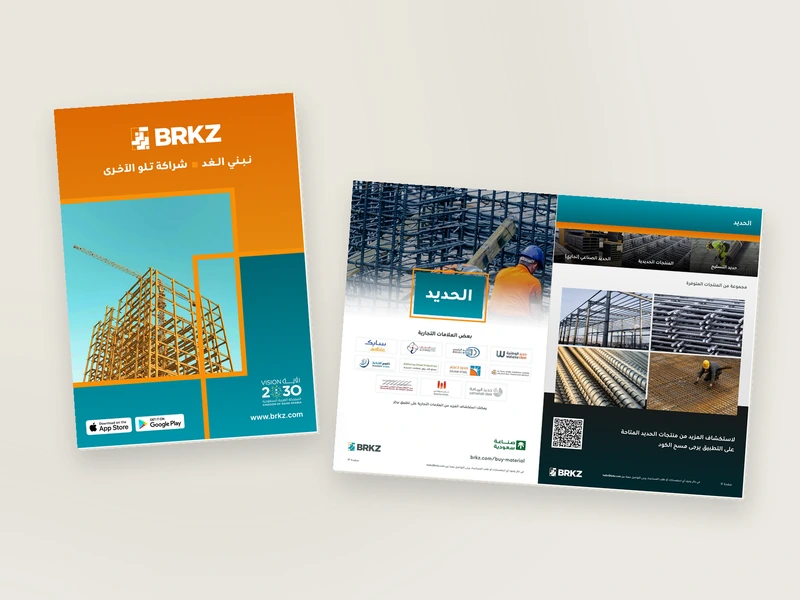
BRKZ needed a company profile to present its business. Our case study explains the page-layout contribution and shows the original company and product artwork. See how company and product information was structured across the delivered pages.
Explore the case studyCommon questions
Do we need a new logo first?
Not necessarily. Share the current logo and brand files so a profile can be planned around them. A new identity is a separate decision.
Who writes the company profile content?
Agree that before design begins. Your team can supply approved facts and copy; writing, editing and translation can be discussed as separate responsibilities.
How long will the profile take?
Timing depends on content readiness, page scope, language versions and review stages. A clear brief and an approval contact help establish a practical schedule.
Your next step
Ready to prepare your company profile?
Share its intended use, available content and language needs. We can help you define the design and delivery scope.